

The Bank Teller Fallacy
We get data on Mythos' impact, I debunk an argument about automation I keep seeing, smart money and dumb money square off, and a commodity potpourri takes place.

Welcome to this week’s edition of The Macro Obsession.
The best round-up of current events and trends in finance, tech, and the real economy currently in your inbox!
Issue #45—Week of May 11th, 2026
Eating Crow, Debugging Firefox
The Way of the Dinosaurs
IQ vs. SPX
Gold & Oil & Diamonds, Oh My!
Eating Crow, Debugging Firefox
I wanted to give an update on something I wrote in “The Chatbot Industrial Complex” (TMO #41). Here’s the relevant section related to Anthropic’s Claude Mythos announcement and the accompanying footnote that I wrote:
There’s tons of content online already about how this new Claude Mythos model will change cybersecurity forever (WIRED). But I’ve heard that kind of thing before, and I’m not fooled by Anthropic talking their own book.*
*I do believe them to some degree that they think their model could be a threat. That’s why they built the Project Glasswing consortium. The question is if they are too close to the thing to tell what’s vapor or not. I expect little to come from this project, but I’m always willing to be wrong.
And wrong I am, it seems. New data has come in now verifying that—at least when in the right hands for the right task (debugging software built on legacy systems like web browsers)—Mythos is paradigm-shifting.1
Lo and behold, Mozilla has become a powerhouse since they’ve been given access to Mythos. They found more bugs in April than in the past 15 months combined.
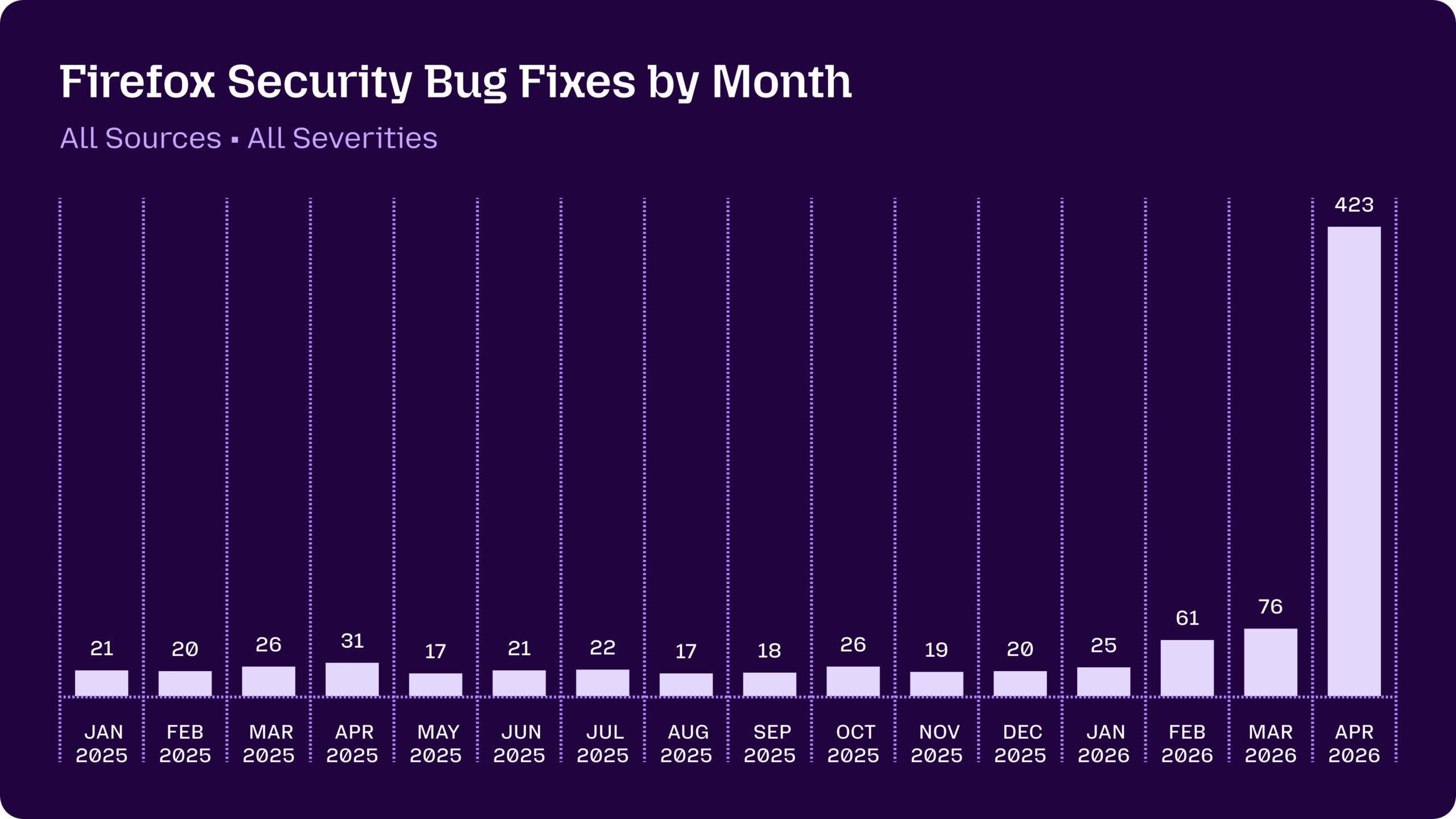
I’m still not a believer that this spells the death of software, because I see the real importance of this paradigm shift: what software is and how it works are going to change, and AI is already doing that.
We’ll get really good at pushing updates, but it doesn’t mean that we won’t make software or update it anymore. We’re already seeing the opposite. This new AI tool has just made a small developer team superproductive at making software.
And yet the iShare Software ETF (IGV 0.00%↑) is still down ~11% YTD.
I haven’t sold my software stocks, but they’re deeply red. As I’ve discussed on Seeking Alpha, I’m adding selectively—I still don’t think the index is the play. Good luck!
The Way of the Dinosaurs
If you learned about economics in a college classroom in the last few decades but before me (a decade ago), you’ve likely seen a chart like the one below, maybe with the dates shifted a little bit. It’s a famous example of a time when the consensus on automation was wrong.
When we plot the rise of ATMs—which folks believed would kill the human bank teller—against actual employee rolls, we see the opposite.
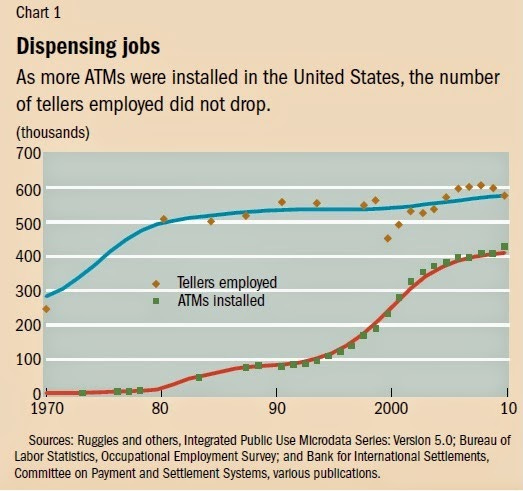
The conventional story is that ATMs took over the easiest parts of a teller’s job, allowing them to focus on higher-value tasks. This allowed for more branches to be opened within similar margins for the banks. That led to more tellers overall.
The problem is that this isn’t true; that was published before mobile banking decimated tellers, causing their employment to peak essentially as the above chart was published.2
And now AI is causing bank teller job losses to accelerate alongside the rest of the knowledge workers, making the updated version of this chart ugly but not surprising for those that read “Rocky Job Market, Solid Bot Market” (TMO #40).
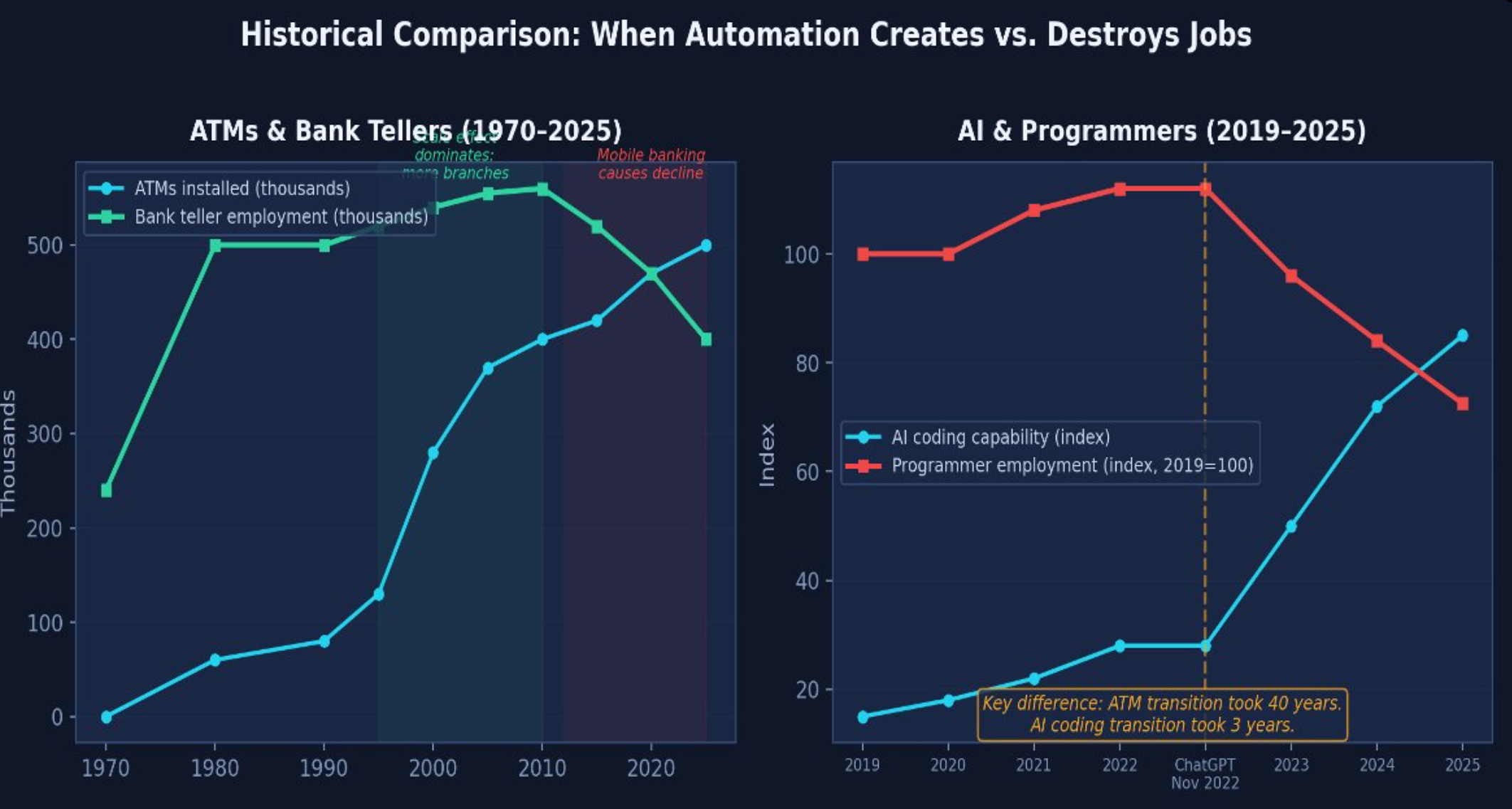
ATMs didn’t kill bank tellers, but ATMs aren’t like AI.
So when I see other variations of this trend as it applies to automation tools, I’m not so impressed.
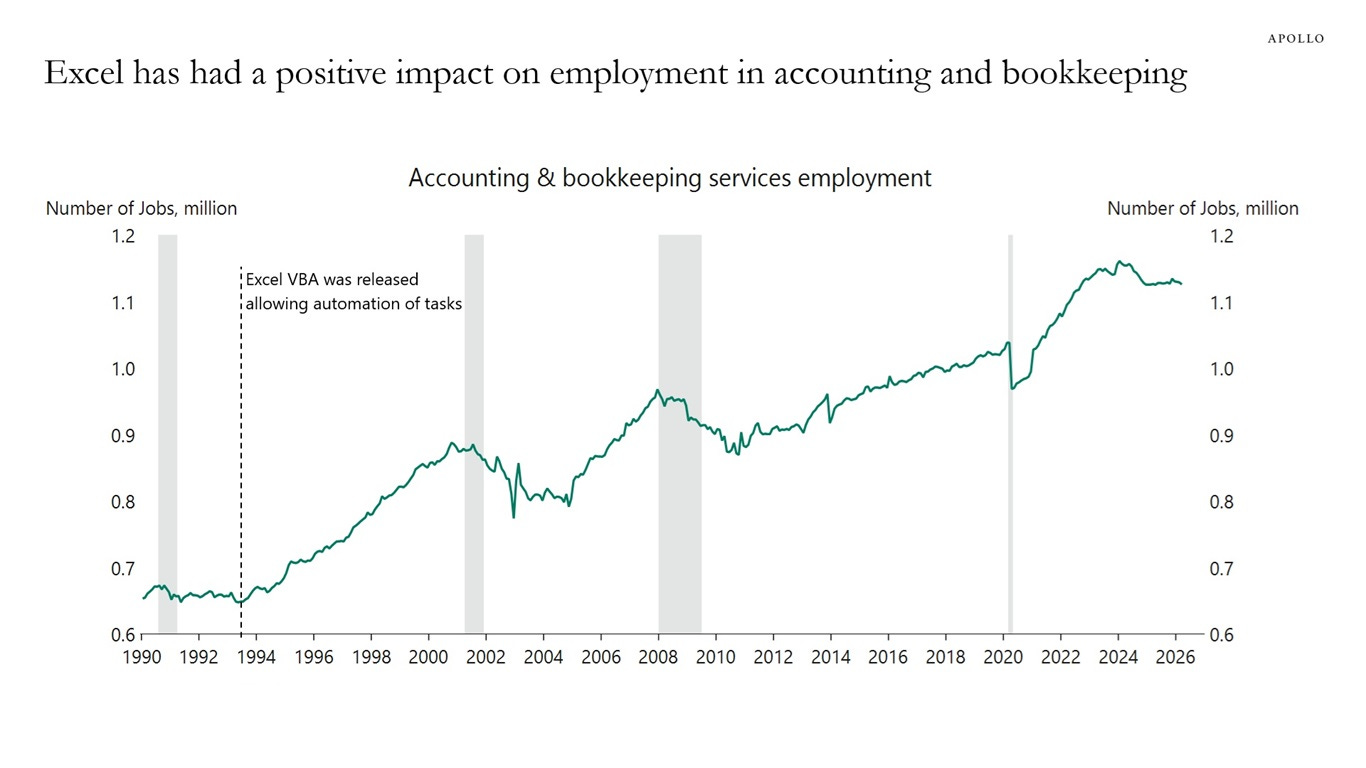
Excel didn’t kill accountants, but Excel isn’t like AI.
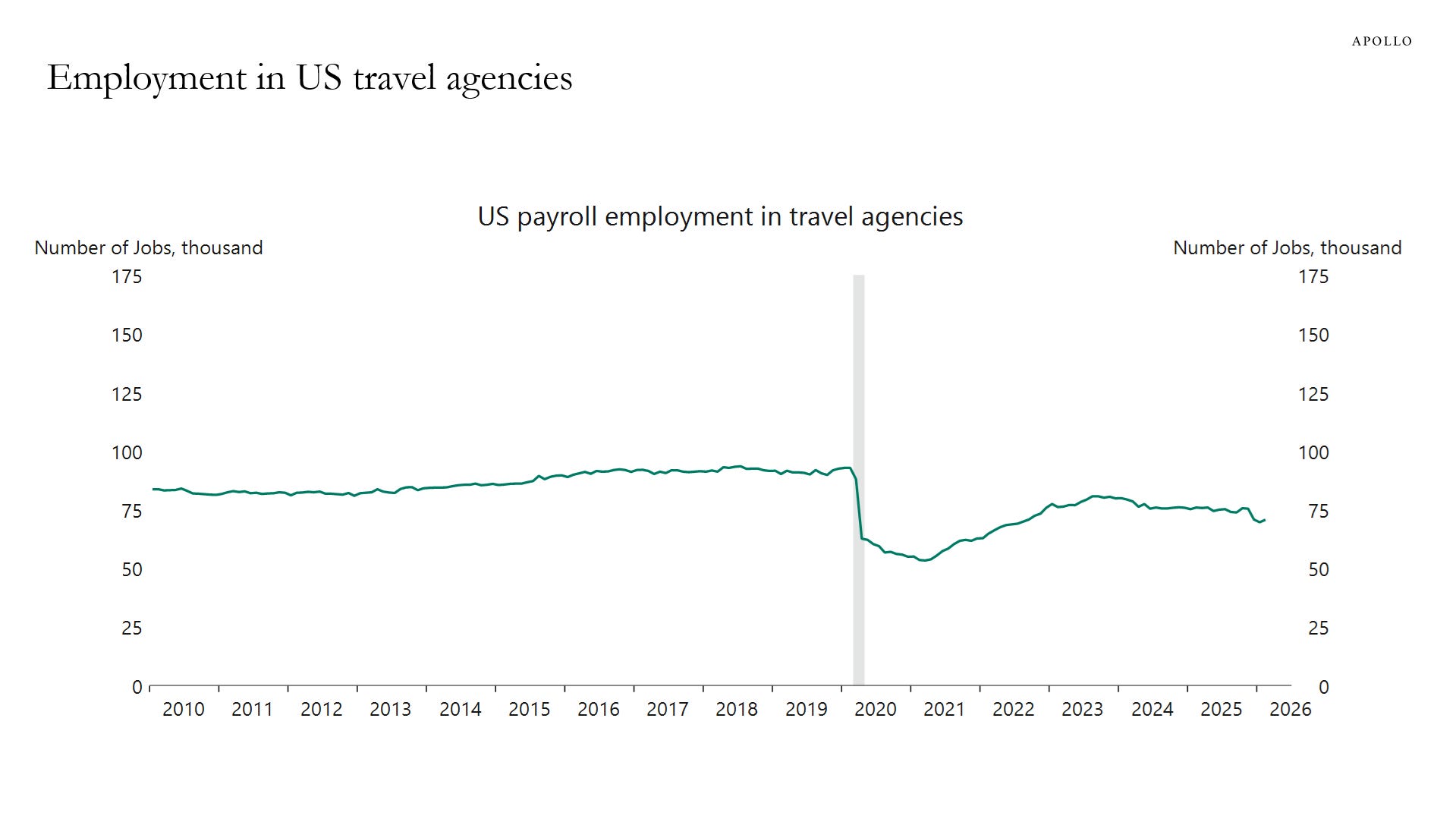
And the global pandemic, mobile, and free Internet competitor tools haven’t been able to kill travel agencies. But those aren’t like AI.3
IQ vs. SPX
Two charts hit my desk this week that I found interesting, regarding who is buying and selling the S&P 500 right now.
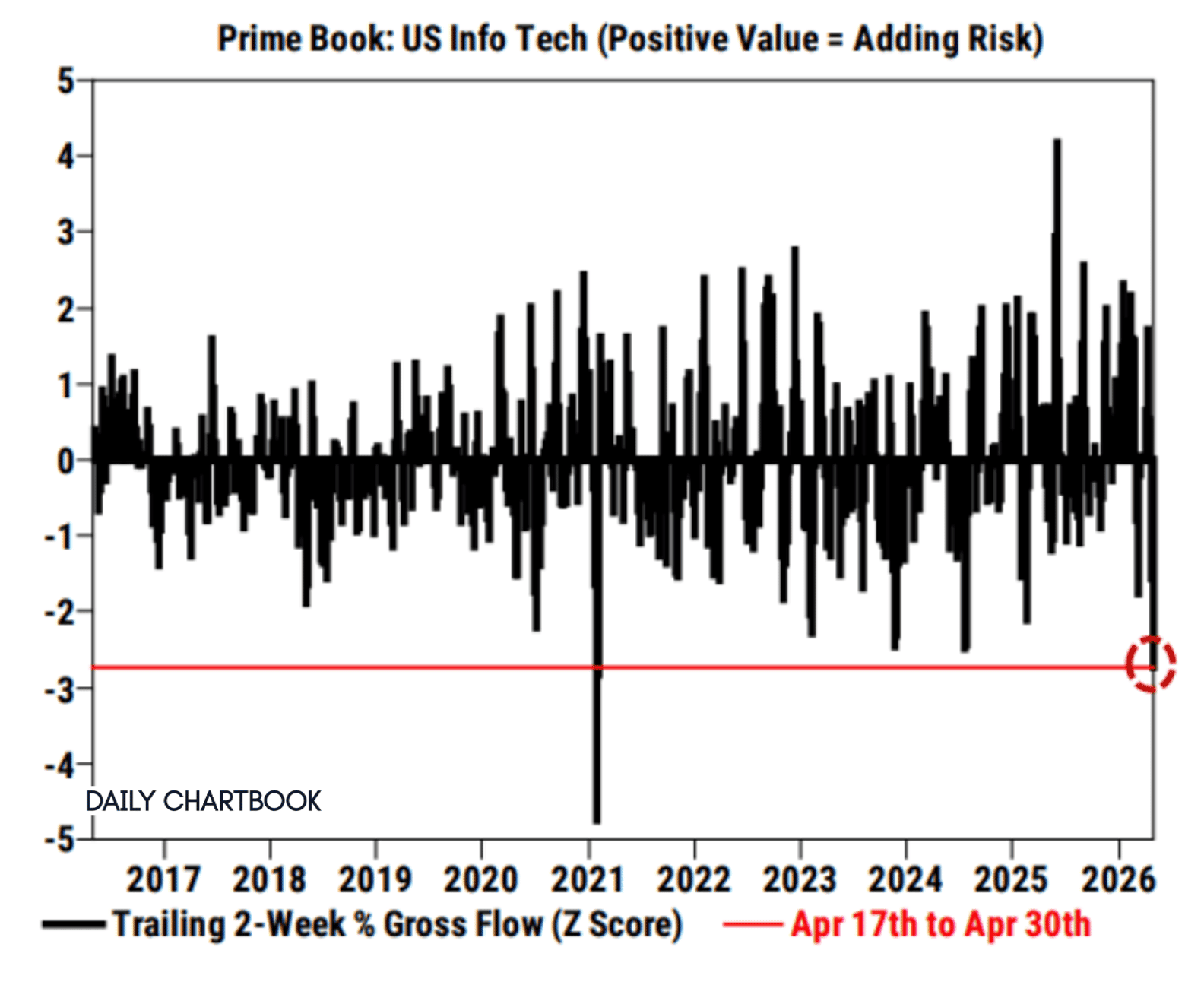
Hedge funds have gone back to selling US stocks, and specifically tech stocks. Even as they continue to rally at all-time highs, hedge funds go further short. They are now at levels below any point apart from the height of the 2021 crypto bubble.
The smart money is selling.
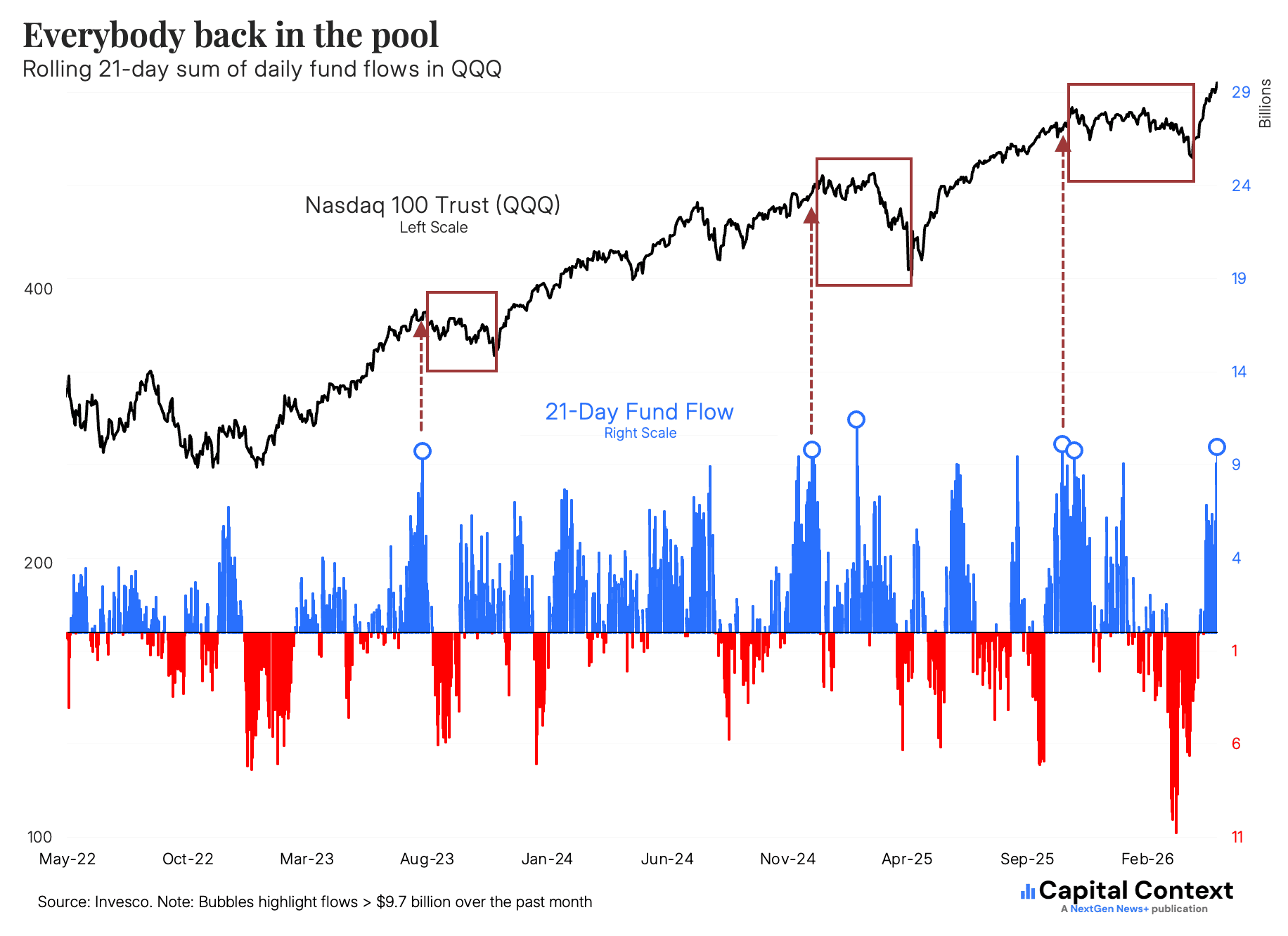
Meanwhile, tech is ripping because there are more buyers than sellers.
We discussed the rationale of buyers in “SPX Earnings Catch On” (TMO #43), and now we’ve got more data on exactly who the buyers are.
The—and they hate this name so much, just ask my Seeking Alpha comments section—dumb money is buying.
I’m still a bull for the record, although I understand that we may be running out of gas to continue going straight up. Short-term traders should brace themselves, but don’t leave the market—it could still be violent and vertical for a little while longer.
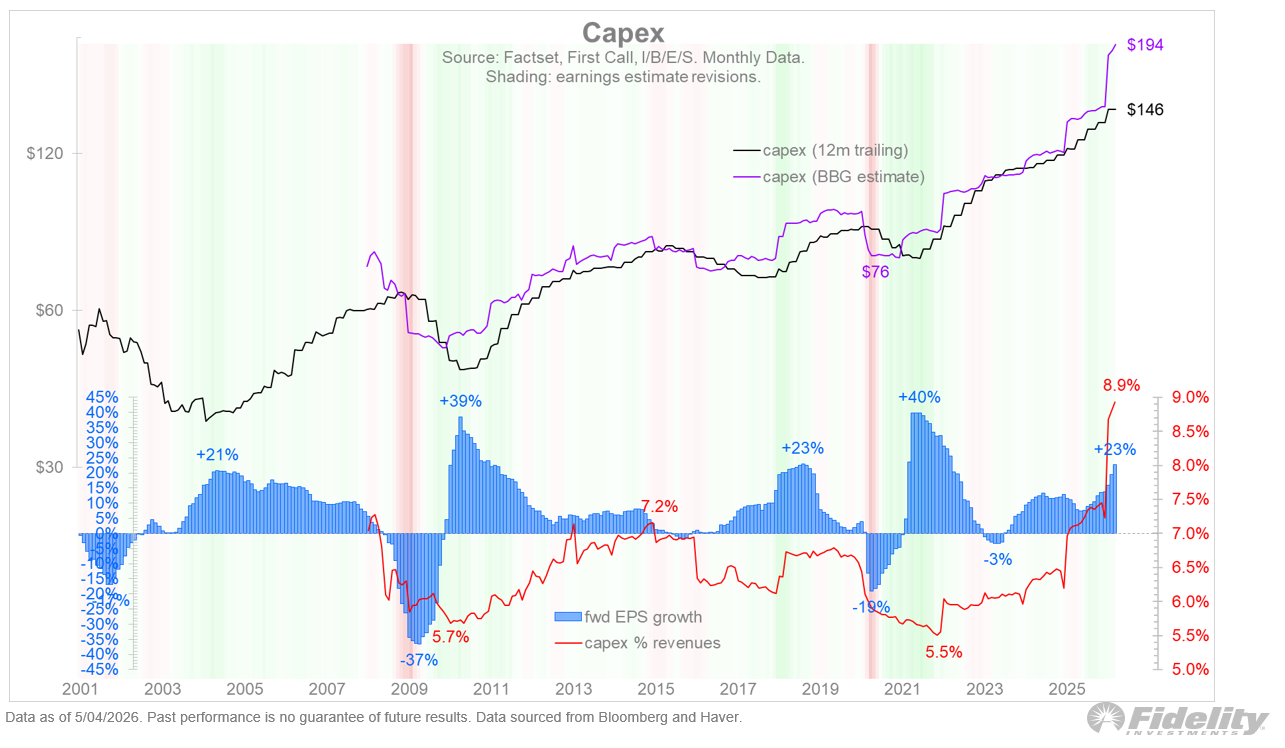
After all, I still think we’re in a market that’s dominated by CapEx spending on AI, and it just keeps rising with every earnings season. So long as this game can keep going, the markets can keep pushing.
What will “come due” for Big Tech is beyond me—some analysts are up in arms over FCF, some over ROIC—whatever it is, that will surface as a justifying narrative. We won’t hear that reason until after whatever correction has already hit the index.
I’ll let you know if I find out what will tell us beforehand, but until then, I can confidently say that this CapEx increase is bullish.
More Below, But ICYMI


Gold & Oil & Diamonds, Oh My!
I’ve got just a few quick potpourri charts to end the newsletter this week.
The first is this one, showing the flow between gold and oil funds. What had been positive movement on the gold front—money flowing out of oil and into gold—reversed steeply at the turn of the U.S.-Iran war.
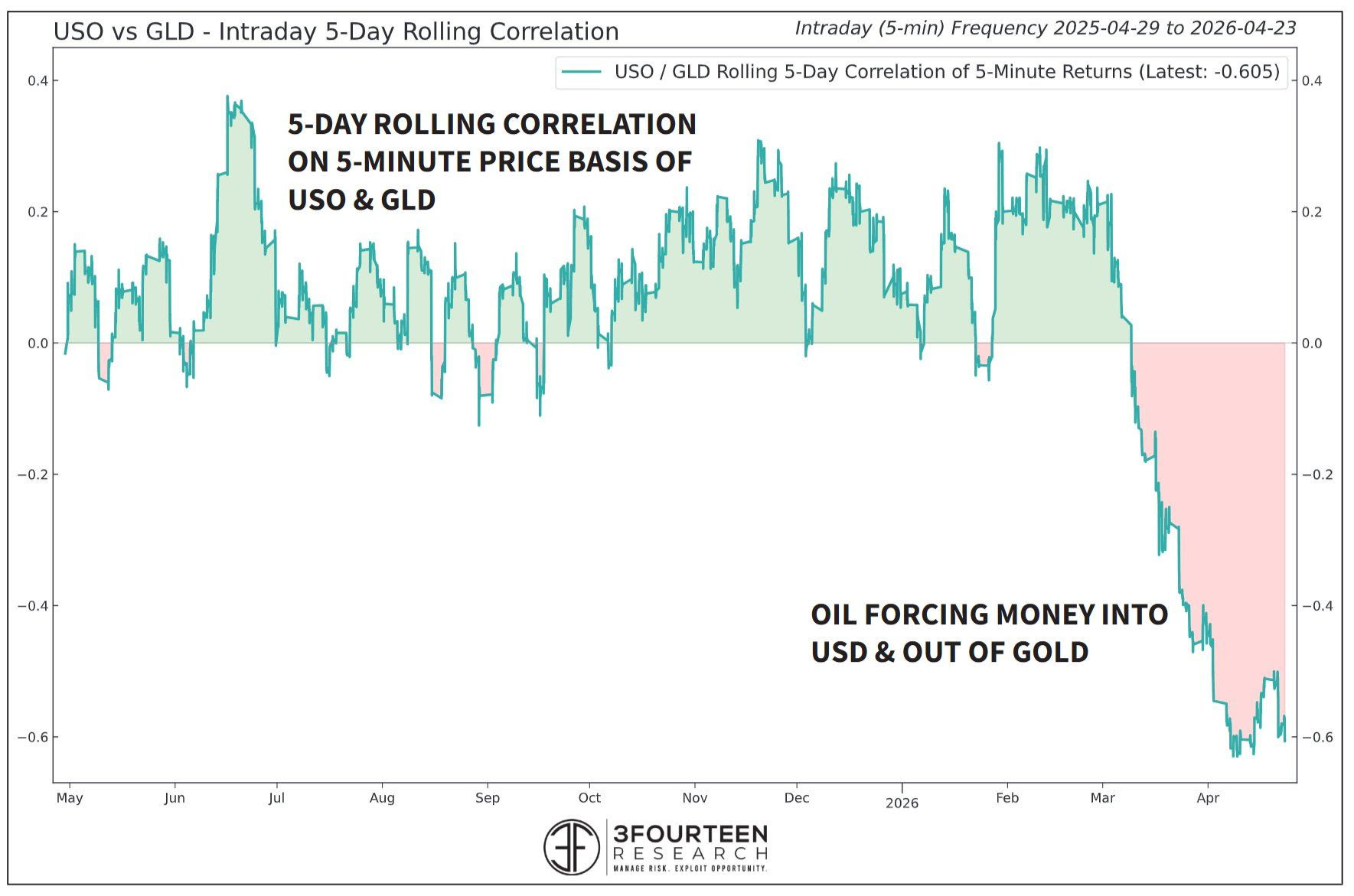
This is what I failed to see coming back in “Safe Haven No More (Revisited)” (TMO #36). Commodities traders have had these on a lever for a while, and missing that meant that I didn’t see the drop in gold coming.
Like many commentators, I expected gold to hold up better than it did (not to rise, but I didn’t expect the severity of the drop). This explains it; the money speculating on oil largely came from the money speculating on precious metals.
While TMO is still long precious metals (see the portfolio update last week on that front), there is something I ran across that I’m glad I’ve avoided for a long time that made me feel better about the near-term losses on the precious metals positions.
Diamond prices, which have been dying due to the rise of synthetics and loss of diamond culture among young people in the U.S., are now collapsing. Ouchie!
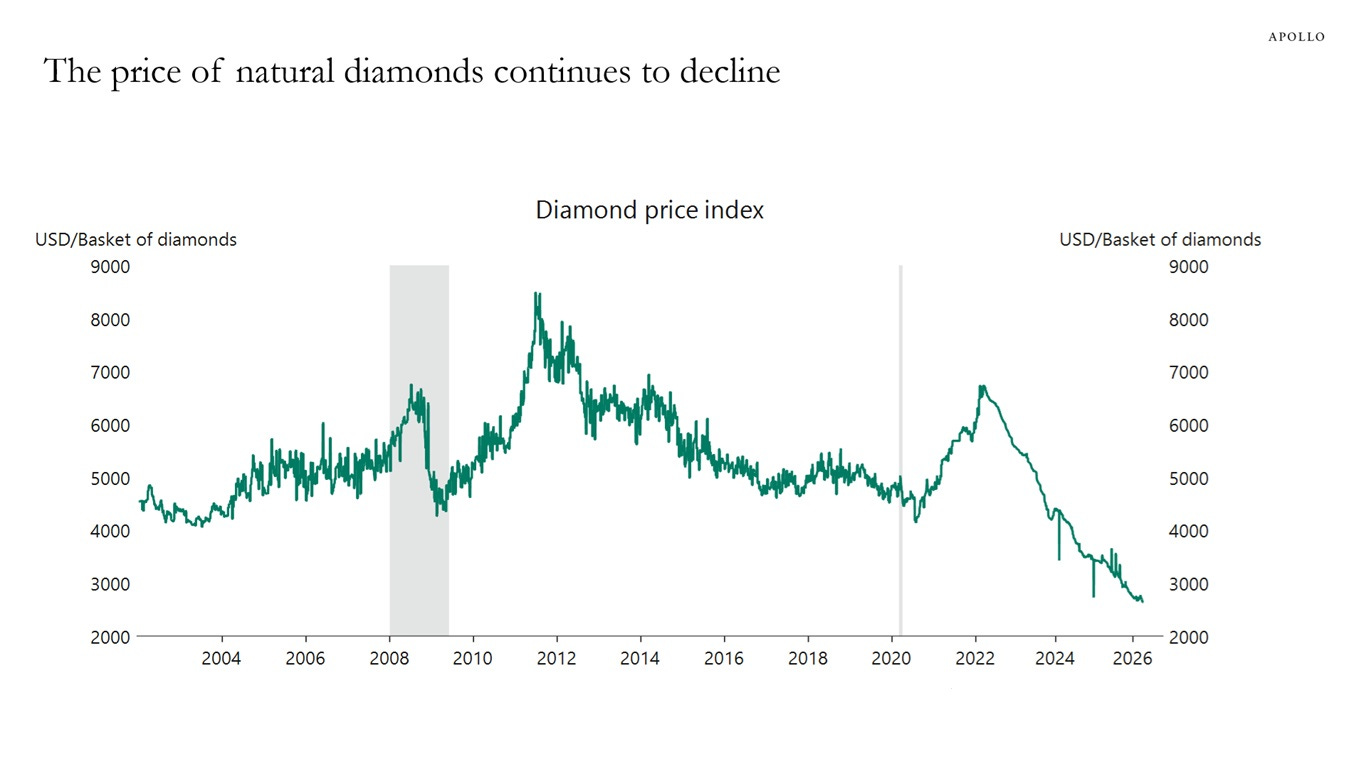
What is your best advice for jewelers? Buy the dip?
If this newsletter made you think of a pal, send it to them and tell them why.
See you next week.
I swear I’m trying to get better about being decisive, but when I make claims like “paradigm shifting,” I can’t help myself but write a qualifying aside with an em-dash AND parentheses included.
At least later if I’m wrong about this too, I’ll have tried to make sure I’m wrong for my core beliefs.
The chart went on to be widely circulated for years and years following—all while the actual bank tellers were in steep decline. It is still posted on social media here and there with pro-AI messaging attached.
It’s crazy to see how stable travel agencies are through business cycles, though, just as an aside.
I think the ATM/Teller comparison stands but in a different sense. These jobs that are being automated are being automated because we've reached a new milestone in human achievement. Being put out of work is a setback but it's going to force people reshape their focus and to use their skills to become more creative, more resourceful and as a result, more versatile. This tool that kicked them out has actually opened their world up to being able to contribute in more meaningful ways and capitalize at a greater level as it did for the teller. How long until they figure that out?
This is a new era for our species. We take for granted how much less bogged down by minutiae our lives our compared to our great grandparents. People's entire lives used to be dedicated to farming and a specific craft prior to the industrial revolution. The most valuable gift of the 9 to 5 culture was not just stability, it was time. Time to create microchips, nuclear fusion, the internet leading all the way up to AI. That time and the need to survive is what spawns creativity and ingenuity. Entrepreneurship is a byproduct of that and the keystone of capitalism. AI gives the average person access to knowledge resources greater than world leaders had in the 90s. We saw a spike in the gig economy during COVID. I think prolonged exposure to AI is going to cause a proliferation of innovation and self made entrepreneurs from all fields and income levels to an extent that we've never seen. The curing of diseases, space travel and settlement. It all opens up from here. This new age is going to be a paradigm shift that far transcends traditional "employment."
Great article man, actually interesting
Subscribed, would love to have you along too🙂🙌