

Buying The SaaSpocalypse
Software insiders square up with retail traders, we measure AI job impacts, and check in on small business hiring plans.

Welcome to this week’s edition of The Macro Obsession.
The best round-up of current events and trends in finance, tech, and the real economy currently in your inbox!
Issue #55—Week of July 20th, 2026
Software CEO vs. Average Joe
The Invisible Hand Took My Job
Smaller Business, Smaller Payroll
Hey folks!
Quick update: there will be no more The ETF Obsession articles moving forward.
If you wanted this month’s list—I didn’t finish inputting all the granular data, like expense ratios and AUM, and it’s missing my opinions—all 95 non-leveraged/inverse funds that launched in June are available in Google Sheet form here.
Readers consistently unsubscribed from the weekly newsletter when they received these reports. The market has spoken, and I will respect it. This is not the venue for my ETF content. I write TMO to get my ideas out to more people, not less. This was a side project for TMO, and it should not detract from the main project, the weekly newsletter. No more scope creep!
I will be moving my ETF content to another place soon (likely its own site), and I will update you when that happens. Paying TMO members, you will receive complimentary access, of course.
If you know someone who unsubscribed from TMO because “Jack sends too much shit,” you can tell them that I have re-committed to only sending out one a week on Sundays, at 6 AM Los Angeles time.
Now let’s get to it!
Software CEO vs. Average Joe
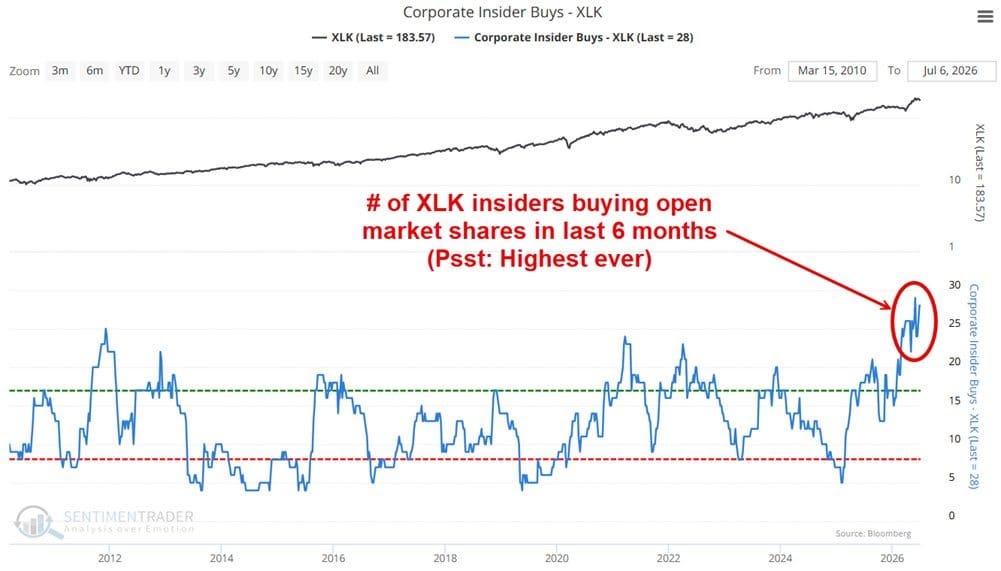
This week, we got an interesting signal that contrasts with a story from last week, “Tech Execs Write Checks” (TMO #54). While technology insiders are buying at a record pace, retail investors have stopped buying stocks.
ICYMI from last week, here’s that chart, which I said reinforced my buy thesis on tech. I got cute and quoted Peter Lynch about insiders only buying for one reason.
Back to retail investors. They stopped their buying last summer, and since this year started, they’ve been slow to add to their stocks. They’re almost in net sell territory now; that hasn’t happened since 2020.
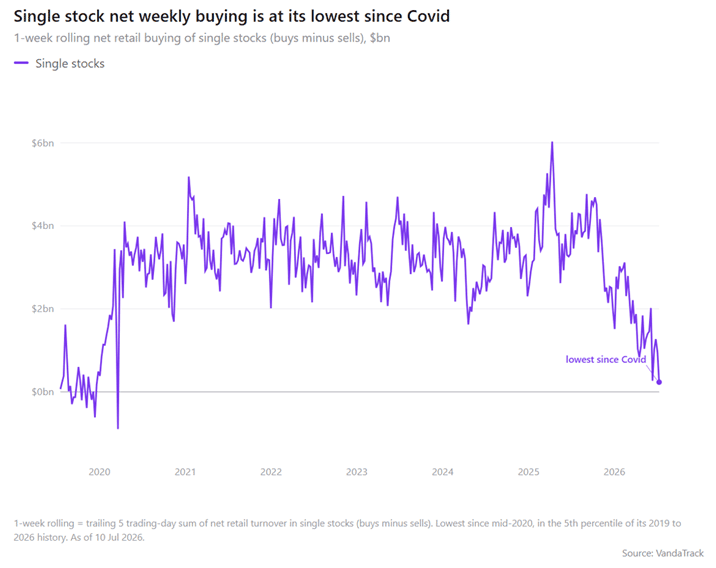
No, this isn’t some slow-motion dying of passive buyers. This metric only tracks single stocks, not funds. This is tracking retail speculation to some degree, although it’s not a track of risk behavior. If it was, we would’ve seen more action in 2022. This has a lot more to do with liquidity and the expectations of future interest rates.
I brought up a related point in “Hawks Run Everything Around Me” (TMO #52) with this chart, showing how flush with cash retail is. This is retail trying to call a top.
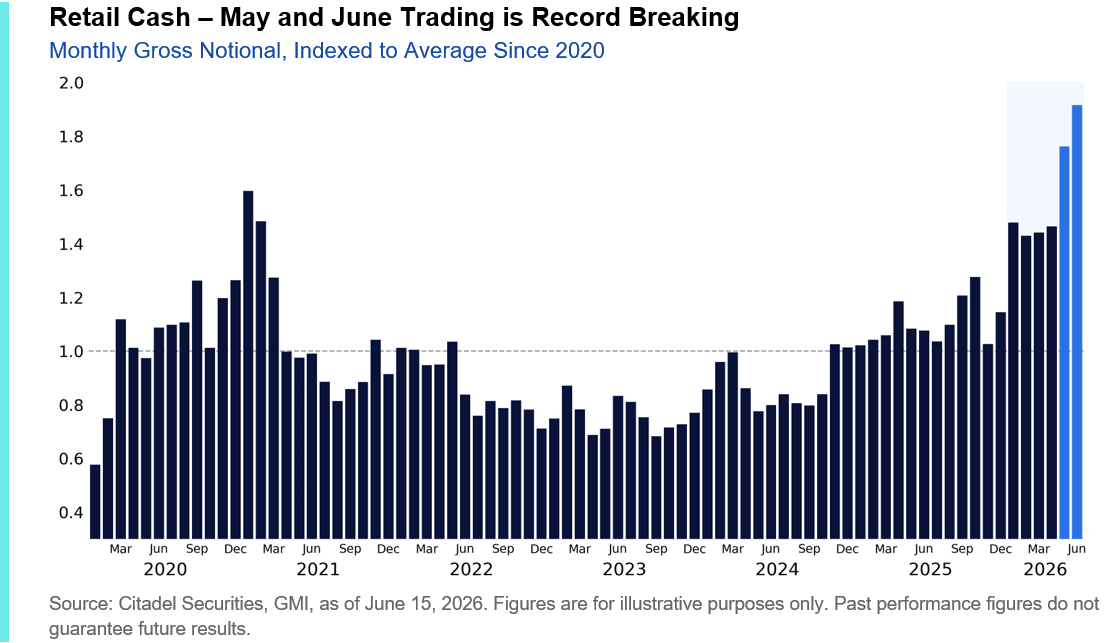
I’m still siding with the insiders on this one and staying long tech.
On that note, I got myself access to a good source of financial data recently. It’s no Bloomberg Terminal—it’s spunky like me—but it lets me look up questions I previously had a very difficult time answering.
When I discussed that tech insiders chart, I had this to say:
I would love to know what the difference is between software and semiconductor exec behavior here. Are these software execs buying the dip of all dips because they have faith in their products not being consumed by AI, or are these semiconductor execs saying the vertical run in chip stocks is just getting started? Those are both “XLK insiders,” but they are buying for very different reasons.
I dug through the companies buying. Lo and behold, it’s all software.
Execs are calling the bottom of the SaaSpocalypse. I think they’re right. That same logic makes me a little worried about semiconductors. Most firms had zero insider buys this year.
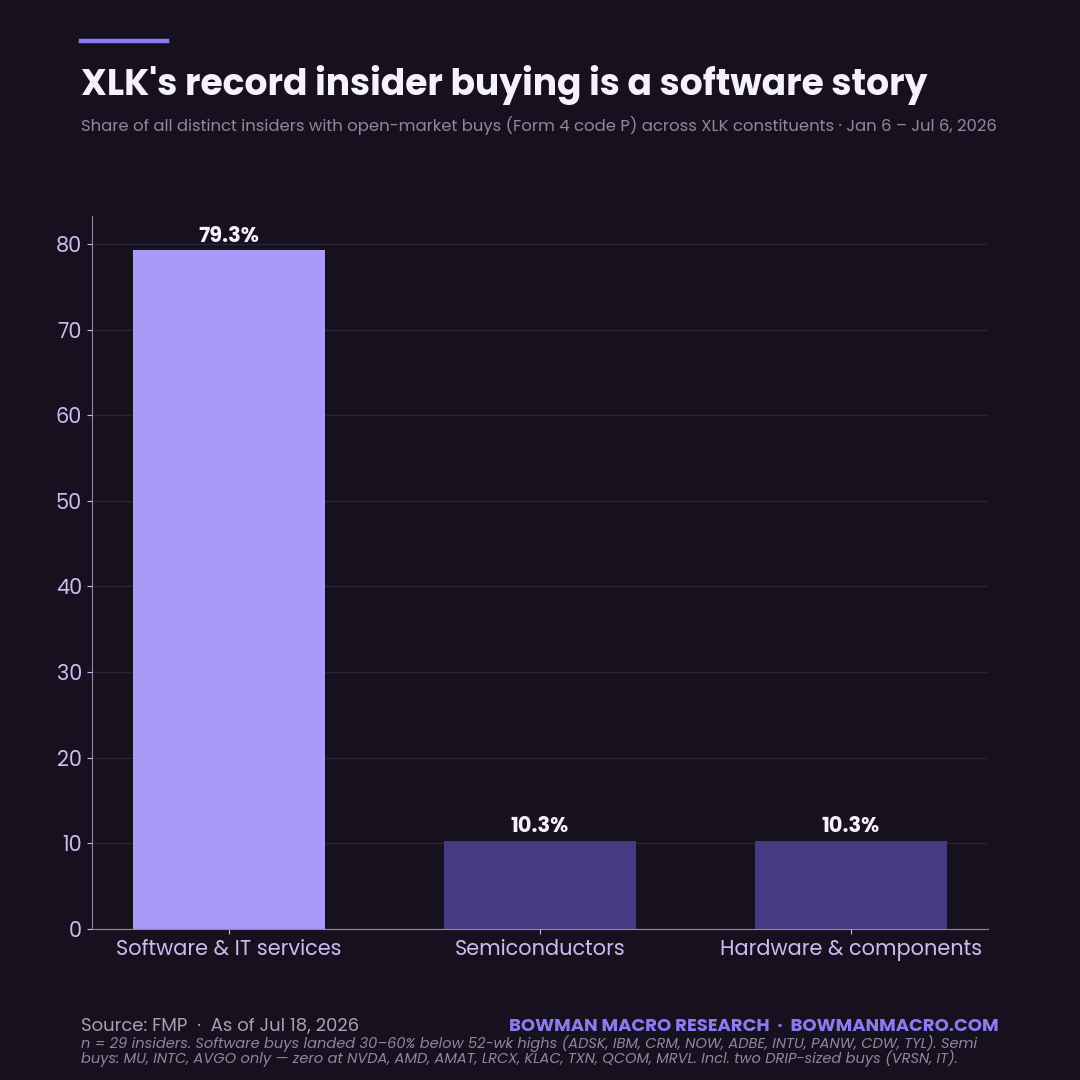
P.S. Send me feedback on the chart. It’s still a WIP.
Think TMO is neat? Send it to a buddy!
The Invisible Hand Took My Job
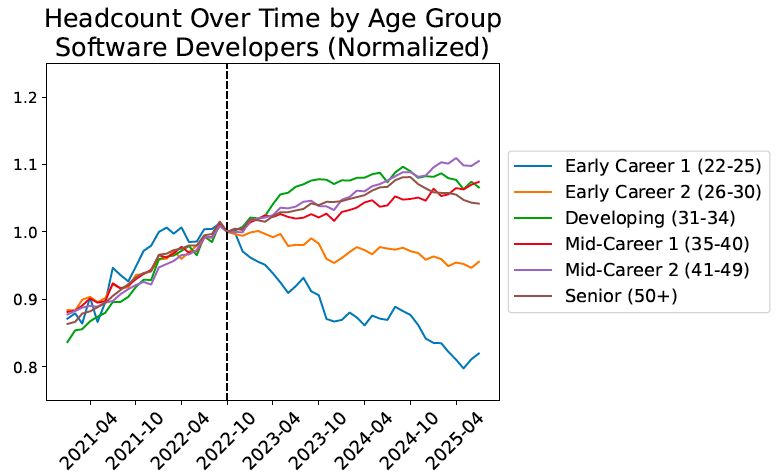
In a story from way back, “Junior Devs Need Not Apply” (TMO #17), I introduced my theory about the impact of AI on the job market. I’ve been honing it since, and whenever we get new data, I try to share it and update our priors.
It all stemmed from this chart, which has become widely shared across TMO issues.
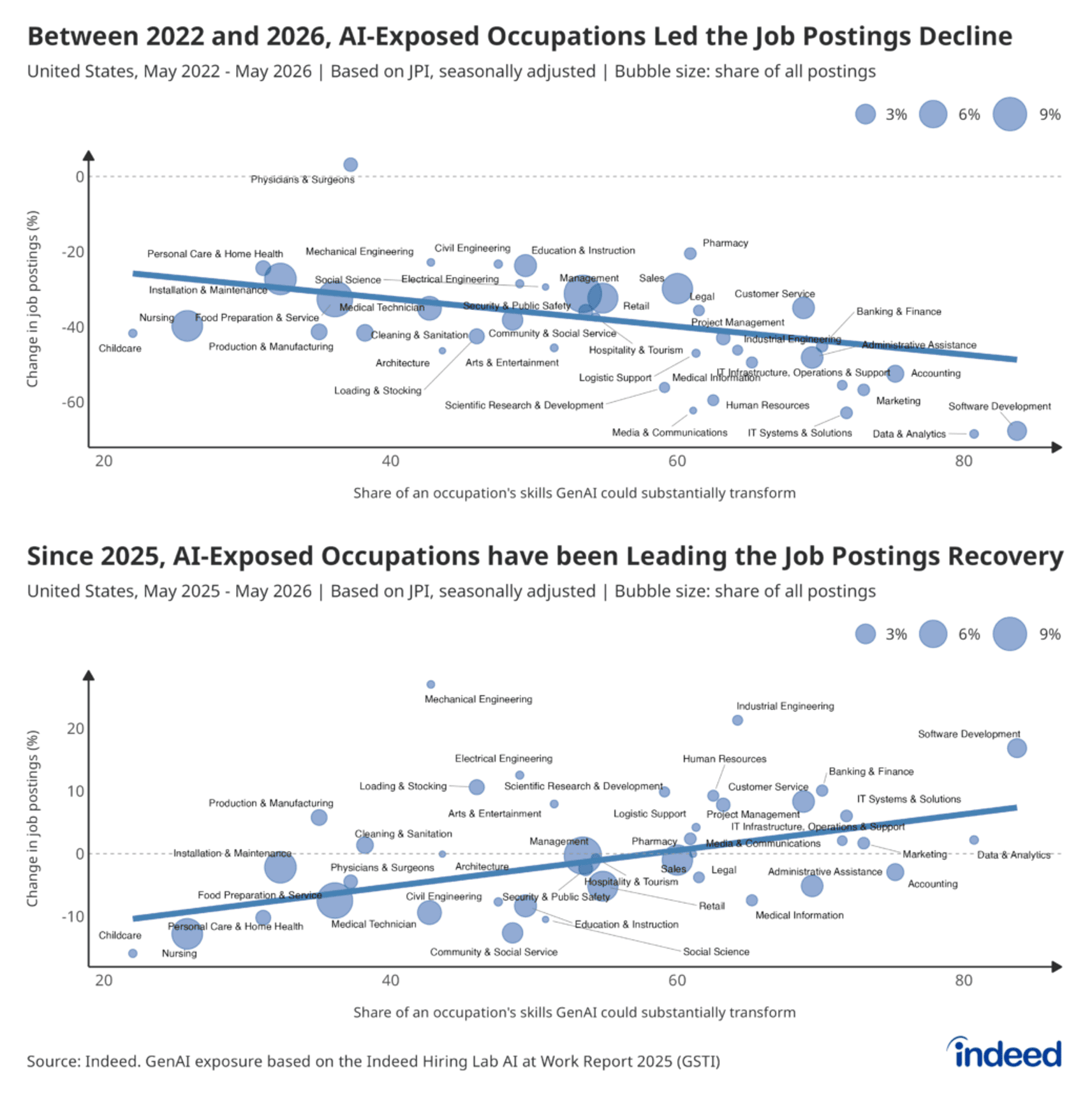
Here’s Indeed data about AI-exposed jobs. They use their own internal report to determine degrees of AI exposure, not the Microsoft report I hate (TMO #19).
As we tracked, software dev jobs were in the toilet over the past couple of years. But now they’re coming back, which we clocked in ”Welcome Back, Junior Devs” (TMO #35). But there’s a lot more good data about other jobs in this chart, including how data jobs are bouncing back, accounting is still underwater, and how we need a ton of industrial engineers.
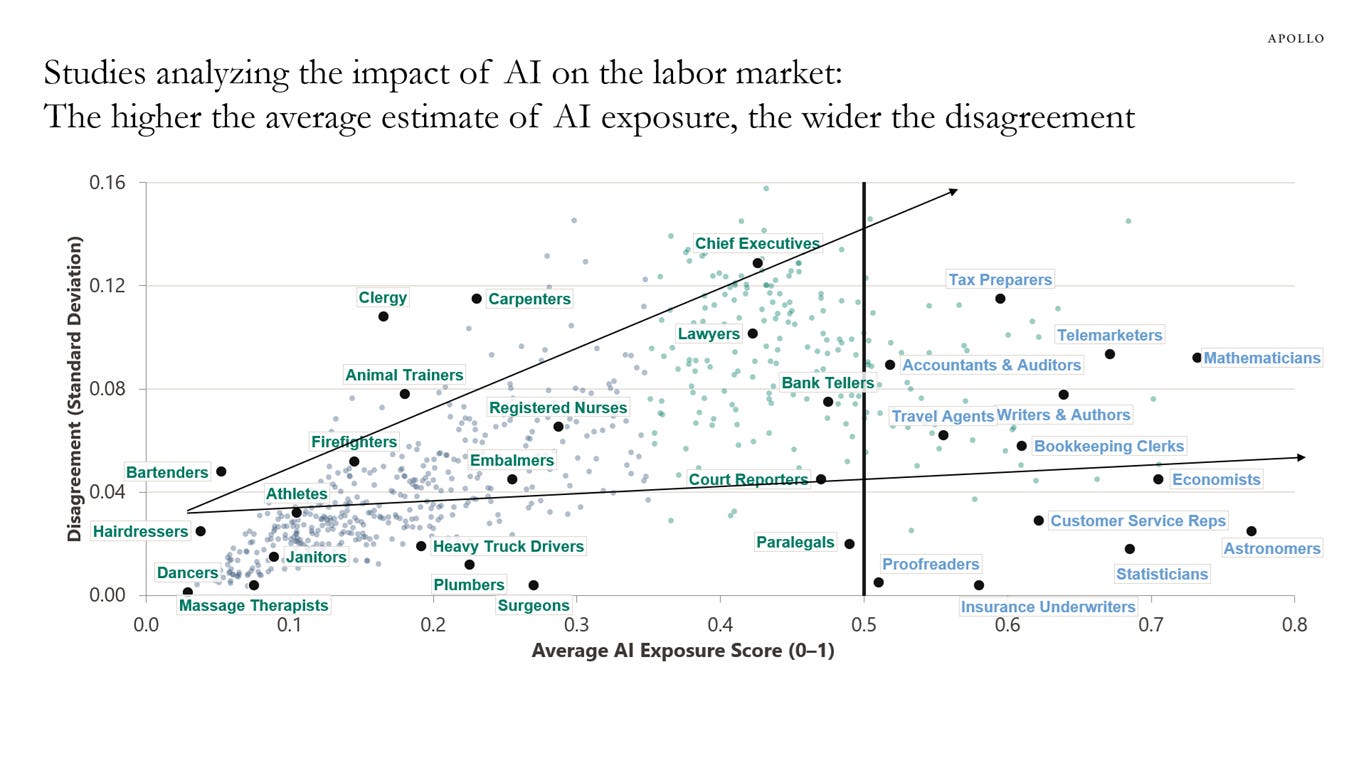
But we should note that the methodologies of all of these reports are suspect to data bending and manipulation. Apollo found that the more agreement there is on AI exposure, the greater the magnitude of their projections.
More AI exposure = more extreme assessments of impact. In other words, the crowd isn’t sure of anything on this front. I’m not either, to be honest.
More Below, But ICYMI


Smaller Business, Smaller Payroll
I’ve been cataloging the rise in small business (“SMB”) applications, both in where they are being filed—see “State Your Business” (TMO #35)—but also in how many people they are hiring.
My theory has been that we’re seeing less hiring in general due to interest rates and the cost to refinance debt that was previously rolled over during the 2020-2022 ZIRP era. Going from paying 4% → 7.5% on your corporate debt means hiring plans falter. Peak SMB hiring was around peak rates, but it’s accelerating lower now.
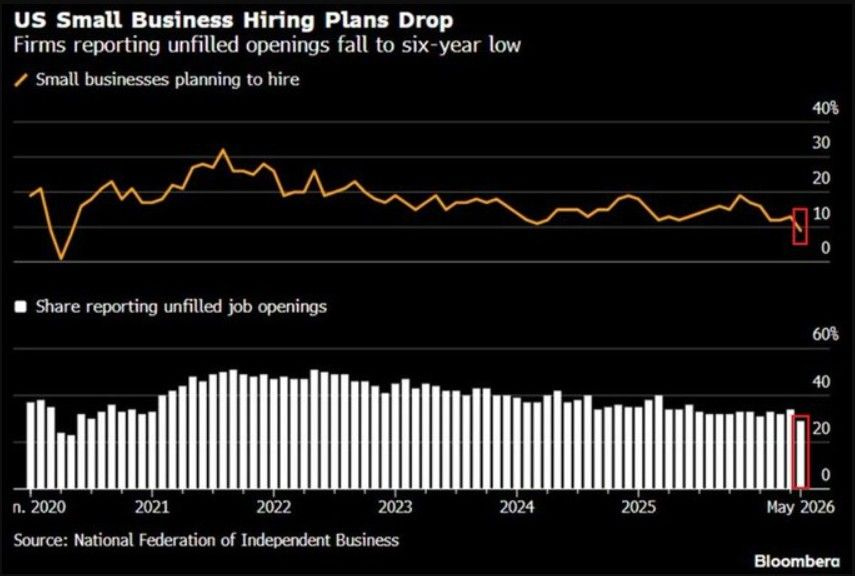
This is problematic because SMBs employ the majority of Americans. Naturally, I am skeptical that this immediately translates into economic pain.
It also could be a symptom of AI, as hiring plans are disrupted not just by rates but by productivity increases from existing employees.
The AI productivity boom affects SMBs far more than it does large businesses—I discussed this and other factors in my mea culpa on AI productivity (TMO #28).
The short of it is that SMBs can leverage low variable costs (tokens) to replace high fixed costs (salaries), which is a benefit that large firms can’t enjoy. Economies of scale dictate that the fixed costs are less of a burden the larger you get. Flip this, and you get a lot of leverage for SMBs that doesn’t translate the bigger they get.
Large language models also seem particularly bad at holding a consistent worldview (something to do with context windows; I’m sure there are better technical explanations that I can offer), which means that the larger the company is and the more moving parts it has, the less likely the particular AI will be useful at working within that system.
That doesn’t mean that the tech won’t be useful in all kinds of places or at large firms, but the advantage that SMBs have not being as complex or large means that they can deploy AI much more efficiently.
So, SMBs, because of the tight financing, are essentially eating the marginal benefits of this productivity boom. It’s cutting into hiring plans not because they aren’t maintaining turnover—we already know that Grandad is already back at work (TMO#37)—but because they are curbing expansion plans.
Bearish, but not as bad as it seems on the surface. I’ll keep an eye out, but I’ve been gutting my small-cap exposure lately. Small caps are still “large firms” for our purposes, but they are more exposed to the real economy than large cap stocks, so it’s a helpful analog.
You can check out my small-cap thesis and the fund I’m consolidating into on Seeking Alpha [GIFT LINK].
Thanks for reading.
See you next week.